Living With CF Today
Daily life with CF involves managing treatments, keeping track of symptoms, and balancing care with school, work, and time with family and friends.
Despite significant advances, treatment burden remains significant, and many people with CF continue to experience chronic symptoms that affect their day-to-day lives.
CFTR modulators, therapies that help improve the function of the cystic fibrosis transmembrane conductance regulator (CFTR) protein, have transformed the treatment landscape and improved outcomes for many people. However, responses vary, and many people continue to experience symptoms, while others discontinue or interrupt treatment due to tolerability issues.
These realities underscore the need to keep moving forward to build on what has been achieved and develop treatments designed to further improve CFTR function and everyday life with CF.
Why CFTR Function Matters
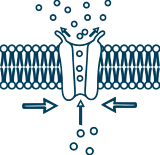
CFTR is a protein found on the surface of cells in organs including the lungs, pancreas, digestive system, and sweat glands. It plays an important role in moving salt and water across cells, which allows organs to function normally.
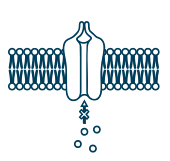
For CFTR to work properly, it must be correctly formed, maintain a stable structure, and reach the cell surface. In cystic fibrosis, changes in the CFTR protein from gene mutations can disrupt these steps, preventing it from forming and functioning properly.

When CFTR does not function properly, the balance of salt and water is affected, and mucus becomes thicker and harder to clear in a number of organs. This can lead to lung infections, difficulty breathing, digestion problems, and harm to other organs. Because CFTR function depends on the correct formation, stability and placement of the protein at the cell surface, improving these processes remains a key focus of ongoing research.
How CFTR Is Structured
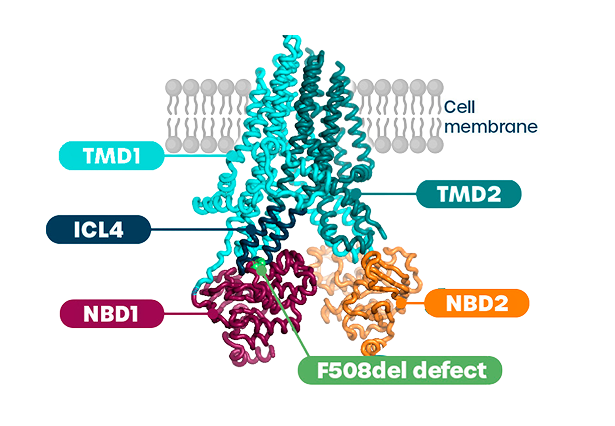
The CFTR protein contains several regions, or “domains”, that each play a specific role in how the protein is formed and how it functions:
Nucleotide-binding domains (NBD1 and NBD2) play key roles in the stability and function of the protein. Stability means that the protein can keep its correct shape, which is required for it to work properly.
Transmembrane domains (TMD1 and TMD2) form the part of CFTR that is anchored in the cell membrane.
Intracellular loop 4 (ICL4) helps coordinate how different regions of the protein form and work together.
These domains must be stable and work together for CFTR to function properly.
Why NBD1 Matters
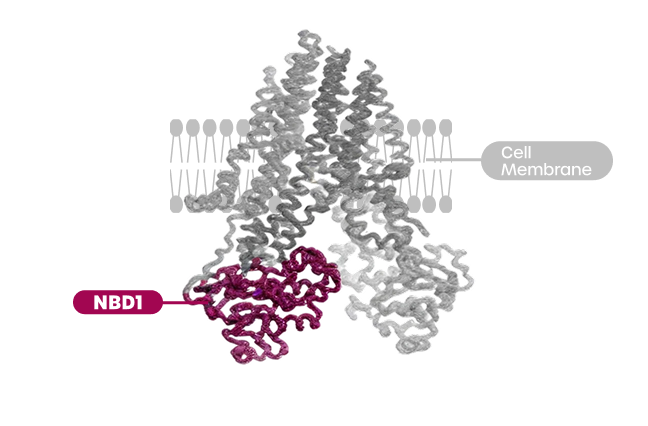
The most common CF-causing mutation is F508del, which affects the NBD1 region of CFTR. This mutation destabilizes NBD1, disrupting how CFTR folds, assembles, and reaches the cell surface. Sionna’s lab studies suggest that stabilizing the NBD1 domain may help F508del-CFTR:
Results from these Sionna lab studies suggest that stabilizing NBD1 has the potential to meaningfully improve CFTR function when combined with another CFTR modulator that targets a different part of the CFTR protein.
How Our Approach is Different
While currently available CFTR modulators improve CFTR function, they do not directly stabilize NBD1, the region of the protein disrupted by the F508del mutation.
Sionna’s investigational NBD1 stabilizers are first-in-class CFTR correctors designed to directly bind to and stabilize NBD1. In lab studies, when combined with compounds targeting other regions of the CFTR protein, Sionna’s NBD1 stabilizers have shown the potential to meaningfully improve F508del-CFTR function.
Sionna’s dual combination investigational therapy pairs SION-451, an NBD1 stabilizer, with SION-2222, a modulator that targets TMD1, another part of the CFTR protein.
This two-drug approach is designed to target two different regions of CFTR. Clinical studies will be conducted to evaluate whether this approach can improve CFTR function in people with CF.
CFTR Structure
Our Clinical Trials
Building on more than a decade of research, Sionna has evaluated its NBD1 stabilizers and other investigational CFTR modulators in clinical trials. The results of these studies are informing the next stage of research.
The safety and efficacy of these investigational agents have not been established. These agents are not approved by any regulatory body for any indication.
What We Studied and What We Learned
PreciSION CF (SION-719)
Completed Phase 2a Clinical Trial Evaluating SION-719 as an add-on to Trikafta® (elexacaftor/tezacaftor/ivacaftor)
Who participated in this trial?
Adults with cystic fibrosis who:
- Had two copies of the F508del mutation
- Were on a stable dose of Trikafta at the start of the trial
What did the trial evaluate?
This trial evaluated the investigational NBD1 stabilizer SION-719 when taken with Trikafta to better understand its safety, and how it affected CFTR function by measuring changes in sweat chloride (a measure of CFTR activity).
What did the trial show?
SION-719 was generally well tolerated when taken with Trikafta for 14 days. Most adverse events reported during treatment were mild to moderate, there were no serious adverse events, and there were no meaningful trends in adverse events related to liver function tests.
The trial did not meet its key activity endpoint: adding SION-719 to Trikafta did not meaningfully reduce sweat chloride compared with placebo.
Based on these results, Sionna is not advancing SION-719 as an add-on to Trikafta.
After reporting those topline results, Sionna conducted additional analyses to better understand the findings.
What did Sionna learn from the additional analyses?
Fourteen participants completed PreciSION CF. Additional analyses identified three factors that may have affected the treatment results:
- Drug-level patterns: Three participants had drug levels suggesting that SION-719 or Trikafta may not have been taken as directed. These patterns may have affected the trial results.
- Lower Trikafta levels: Levels of the three medicines in Trikafta were lower during SION-719 treatment than during the placebo period, which may have reduced the effect of adding SION-719.
- Possible interaction with ivacaftor: A review of laboratory data suggested that an interaction between SION-719 and ivacaftor, the potentiator in Trikafta, may have limited the additional effect of NBD1 stabilization.
One of the additional analyses looked at changes in sweat chloride using measurements taken at the start of the SION-719 and placebo treatment periods.
In this analysis, when data from the three participants with the abnormal drug-level patterns were not included, SION-719 reduced sweat chloride by an average of 8.6 mmol/L more than placebo. When all participants were included, the average reduction was 1.1 mmol/L more than placebo.
Sionna believes these findings suggest biological activity from NBD1 stabilization in the trial.
Trikafta® is a registered trademark of Vertex Pharmaceuticals Incorporated
SION-451 Dual Combinations
Completed Phase 1 Clinical Trial of Sionna’s Investigational Dual Combination Approach
Who participated?
Adults who do not have cystic fibrosis (“healthy participants”).
What did the trial evaluate?
This trial evaluated SION-451 in two different two-drug combinations:
- SION-451 + SION-2222
- SION-451 + SION-109
Researchers evaluated the safety of the combinations, including how they were tolerated, and how the body processed the medicines when taken together. Each combination was designed to target NBD1 plus another region of the CFTR protein.
Why were people without CF included?
Phase 1 trials are often conducted in adults without disease to help researchers better understand the safety of an investigational medicine and how it is processed in the body before it is studied in people living with a condition like cystic fibrosis.
What did the trial show?
Both combinations were generally well tolerated and reached the planned drug levels Sionna was targeting. In the SION-451 + SION-2222 groups, a small number of participants discontinued study treatment due to side effects.
Based on the overall Phase 1 results, SION-451 + SION-2222 was selected as the combination to advance into the next stage of clinical research.
How is this research informing what comes next?
Together, the findings from the post-hoc analysis of the PreciSION CF trial and the Phase 1 dual combination trial informed Sionna’s decision to advance SION-451 + SION-2222 into a Phase 2 clinical trial.
SION-451 + SION-2222 is a two-drug combination that targets NBD1 and TMD1. This combination does not include a potentiator and is not intended to be taken with Trikafta.
What’s next?
Sionna plans to evaluate SION-451 + SION-2222 in a Phase 2 trial in adults with CF who have two copies of the F508del mutation. The trial is expected to begin in the first quarter of 2027.
Read more about the PreciSION CF findings and Sionna’s plans for SION-451 and SION-2222
Forward-Looking Statements
This page contains forward-looking statements. These include statements about Sionna’s plans for a Phase 2a trial of SION-451 + SION-2222 and its expected timing. They also include Sionna’s interpretation of the PreciSION CF trial results and the potential of NBD1 stabilization to improve CFTR function. These statements are based on Sionna’s current expectations and involve risks and uncertainties, and actual results may differ materially. For more information about these risks, see “Risk Factors” in Sionna’s most recent Annual Report on Form 10-K and later filings with the SEC. These statements speak only as of the date they are made. Sionna undertakes no obligation to update them except as required by law.
October 6, 2026